Sunday, May 18, 2008

Hill Country Gardens, Part Three

After a picnic lunch at tables with white tablecloths amid the splendor of Dunaway Gardens, we caravanned north on Route 70 then east on the South Fulton Parkway to Wilkerson Mill Gardens, owned by Elizabeth (shown above) and Gene Griffith. Wilkerson Mill is a nursery open to the public, specializing in hydrangeas. Elizebeth joined us for an hour, talking about the history of her developing sense of place on the thirty acres where she and her husband live and work in the Chattahoochee Hill Country. She began by leading us into a sheltered corner of her garden sales area, to talk with us about creating inviting living spaces with plants.
Then she led us on a ramble along some of the mown paths on her property. We wandered past a host of intriguing shrubs, some in bloom, others with fascinating leaves or patterns of growth.
Elizabeth told us how she and her husband, around twenty years ago, first acquired the land and decided to move there to establish an orchard. As the land was cleared for planting, she began to feel terrible about all the destruction that was involved. She was told by a mentor that she should find the most stunning tree on the property, go to that tree, and ask for forgiveness for the desecration by pouring all the energy of the loss into that tree. She explained that one tree stood out by far as the one she had to visit. It was a white oak hundreds of years old, probably even older than the grist mill on the property that dates from the 1860s. Just the day before, she shared with us, the tree had fallen abruptly in a strong wind. The loss was not entirely surprising -- after the stress of severe drought last year, the storms of spring have done a tremendous amount of damage to trees, especially elder ones, in and around the Hill Country. Still, she explained, she feels the oak's demise deeply. Connection to place carries with it a susceptibility to the anguish of loss.

We came, at length, to where the great tree lay. The oak leaves were still green and fluttering in the light breeze. Amazingly enough, the tree fell in such a way as to block access to the mill, yet did not damage the historic structure in any way. It did relatively little damage in its fall, she explained, apart from flattening a pop-up camper belonging to a visitor who was doing some work on the property (who was not in it at the time, of course). We paused to admire the mill itself, with footings carefully shored up a few years back, by an Amish family from Michigan. Alongside the structure, the overshot wheel still stands in the millrace. This mill is the last of its kind, the only mill still standing relatively intact within the Chattahoochee Hill Country.
Our forward advance thwarted by the fallen oak, we retraced our path to some stone steps back up into the garden sales area. From there the group dispersed. Valerie and I were distracted by possible plants for our own three acres. We carried home in the back of our car a red buckeye, some Japanese painted ferns, and a Franklinia -- an understory tree that Valerie had been craving since our arrival in Georgia, named by William Bartram in honor of Benjamin Franklin, discovered in southern Georgia on his travels there, but now thought to be extinct in the wild. But that is another story, one that Mike Cunningham had shared with us nine days before....

Hill Country Gardens, Part Two

It was quite possibly perfect weather: temperature somewhere in the upper 60s, cloudless sky, gentle breeze. The date was Saturday, May 17th, the day of our outing to two local gardens: Dunaway and Wilkerson Mill. Eleven of us met at Hill Country Montessori School at 10 am to carpool to Dunaway Gardens, about fifteen minutes west and south of the school. To my surprise, I later learned that the Gardens are in the same watershed as our school: Cedar Creek, tributary to the Chattahoochee River. (The site borders on a spectacular 65 acre wetland, which I plan to visit again on our August outing featuring birds and flying insects.) Our tour guide was Josh, son of Jennifer Rae Bingham, garden owner. A realtor by profession, Josh spoke reverently and enthusiastically of the site, and told us many times about ongoing efforts to protect adjacent parcels of land from development.

In turn, I shared with Josh some of the "inside stories" I had learned from a member of our workshop group who was unable to attend our garden odyssey. He had sent me an email earlier that morning, sharing some of his memories of the historic gardens (particularly during its hayday in the 1920s, 30s, and 40s when it was a theatrical training center operated by Hetty Jane Dunaway and her husband, Wayne Sewell). Here are some of those stories:

"...as a child, from the age of 11 to about 14 or 15, I used to go to Dunnaway and help Ms. Hatchett cut back the hedges from the paths, mow the grass, and other things every summer, just so I could have access to the gardens, and spend time with Ms. Hatchett. She was the "beloved neice" that is pictured on the Dunnaway Gardens web site to which the gardens were left after the Sewells passed away. Being a teacher, she did not have the money to maintain the gardens in the way they should have been. However, she did have a wealth of memories she always shared with me. The gardens were originally designed as a series of outdoor rooms, with huge hedges seperating the view from one area to another, so going up a set of steps, or around a corner, always brought a new surprise. There were sculpture in the Roman gardens from one of the local art guilds, paintings in many of the buildings from other art guilds, etc. I think there were three or more art guilds showing their works in the gardens at one time, if my memory serves me correctly, so it was more than just a garden. It was the local center for all the arts, performace art, painting, sculpture, music, etc. Walking through the gardens, you would always see original art, hear live music being played in the background, smell steak and other meals being prepared in the different resturants, etc. (In addition to the Tea House, there was a steak house resturant in the bottom of the Honeymoon house...). There was also a series of cabins at the back of the property where the visiting actors and actresses would stay.

Some of the more humorous, and somewhat scandalous, memories Ms. Hatchett shared were tales about the rock mason who laid most of the garden walls and steps. Evidently he was somewhat of a lush, and Hetty Jane would often find him passed out on the job, or asleep somewhere in the gardens, as she was hosting guest or events. He did good work, and Ms. Dunaway would always forgive him.

Another reason the gardens were once more popular than they are now, according to Ms. Hatchett, was the Japanese Tea House. She showed me a menu once, explaining to me the significance of many of the items. It seems, especially during the Prohibition, that the socially elite ladies of Newnan would come to the gardens on a daily basis for "theraputic teas". It was a daily thing, much as the English have their tea time. The difference was that there was a tea for neuralsia, which included coca extract (cocaine). Another for body aches and pains which had a bit of morphine in it. On for "dropsy", or depression, which had extract of cannabis, etc. All of these medications were over the counter at the time. Ms. Hatchett told me that it was a hoot for her as a young lady to see all these socialites come together in their gowns, white gloves, and lace hats, get their "tea on" (as she called it), the entire time complaining about their h usbands attending the local speakeasies or catching their husbands bringing in the latest batch of shine from the local moonshiner, etc."

I appreciate tales like these for the window they offer on how the gardens truly were -- not simply the picture-postcard views of smiling movie stars amid flowing pools and blooming roses.

Below are a number of photographs from our walk. I was taken, in particular, with all the shady pools and channels of flowing water edged with ferns and mosses. We stopped at a number of large pools, some murky and others with tadpoles or small fish swimming in the shallows. At the base of the Great Pool, under the shade of an enormous beech tree, Josh told us another marvelous story. That stony terrace, which overlooks the wetlands of Cedar Creek, was a favorite haunt of a local fortuneteller who made a living as a soothsayer. She had one good eye, with the other made of red marble, and she dressed in military clothes. Ms. Dunaway's son wanted her to leave; before she left, she told him his fortune, mentioning that he would wreck his Model T Ford by accidentally driving it into the creek; that very thing happened two weeks later. Shortly afterward, the fortuneteller returned to ply her trade at the Great Pool. Another favorite spot of mine was the Wedding Tree, a white oak approximately 200 to 250 years old. Finally, the geologist in me was taken with Little Stone Mountain, an exposure of gneiss that, according to the Dunaway Gardens brochure, was "often described as the favorite campsite of Chief William McIntosh." In my mind, I travel full-circle, to January's field trip to McIntosh Reserve. The more I learn of this region's stories, the more I am haunted by them.

Hill Country Gardens, Part One

For the month of May, our Sense of Place workshop theme was gardens and gardening in the Chattahoochee Hill Country. The Thursday evening talk was given by Mike Cunningham, co-owner (along with his wife, Judy) of Country Gardens Nursery in Newnan, Georgia. Meeting in The Studio, a new space in Serenbe Community with doors opening into a courtyard with a fountain and lovely plantings. Eight of us attended the talk, in which Mike shared information on about thirty native plants, including histories of their discovery in the wild, uses by wild animals, and site characteristics for optimum growth. Mike also brought along several of the plants he was discussing, including a stately red buckeye (in bloom), sweet shrub, and native wisteria. I am grateful for Mike's advocacy of growing native plants; I welcome the prospect that a homeowner could enhance conditions for wildlife, particularly birds and pollinator insects. Mike himself is an exceedingly kind and considerate person, who not only agreed readily to speak in our workshop series, but also showed up at Hill Country Montessori on short notice (and feeling unwell) to consult with the school on a garden grant application. His depth of knowledge is stunning. As fate would have it, our car was in the shop, so Mike drove Valerie and me back to our house. We took advantage of his stop to ask a few questions about planting native species on our property (particularly with an eye toward replacing the boxwoods and nandina that I abhor). I bought one of his "demonstration plants", a native wisteria, and planted it the next day in front of a decorative well house in our front yard. I can't wait for it to cover the structure in a late-spring blanket of sweet purple blooms a few years from now.

Wednesday, April 23, 2008

Art in the Hill Country, Part Five: Panola Mountain Landscapes


Finally, I arrive at a series of photographs I took once the novelty of hand lens photography diminished somewhat. After looking closely at individual plants and even parts of plants, I began to wander around the hilltop, noticing patterns made by the alternating colors and textures of various plants, against the background of the Panola Granite. Everywhere I turned, a new and glorious tapestry beckoned; carpets of moss and diamorpha, or an "island" of diamorpha and sand bounded by the edge of a large, shallow depression in the rock surface.

Despite the hour-long drive to Panola Mountain State Park, I am confident that we will return there someday in a future Sense of Place Workshop series, perhaps in 2010. Although the site is not strictly in the Chattahoochee Hill Country (it lies within the Ocmulgee River watershed), I would gladly to extend my bioregional horizons to include the entire Georgia Piedmont, just so that I could consider Panola Mountain as part of my home place.


Art in the Hill Country, Part Four: Panola Mountain through a Hand Lens

As I wrote in an earlier installment in this series, once we stopped to sketch I worked for a while on a crossvine drawing, then wandered away from the group, drawn by thousands of possible subjects to photograph. After I had taken a few quick close-ups at the "flower" setting on my Kodak EasyShare, Brian (our park guide) suddenly asked if I had considered trying to take photographs through a magnifying lens. He remarked that he had never done such a thing, but didn't see any reason why it wouldn't work.

I am astonished to say that the results were beyond expectation. Armed only with a Belomo Triplet 10X and a basic Kodak camera, I was able to get some impressive detail and clarity in photographs of flowers, lichens, and even male pinecones. I held the hand lens as flat as I could against the digital camera lens, set the lens for the close-up ("flower") setting, and tried to focus the image. If it focused, I depressed the button fully and took the photo; if not, I moved the camera-and-lens closer to or farther from the subject, and tried again. I felt like a young child with a new, exciting game to play, as I frolicked about the face of Panola Mountain, looking for new subjects. Before long, Brian borrowed a second lens from me, and joined in the game. (He appears in the picture above, hunched over a specimen with his camera and magnifier, on the right side of the photograph.)

My favorite "captures" are shown below. The first three flowers are, in order from top to bottom: sandwort (Arabis laevigata); sunnybell (Schoenolirion croccum); and diamorpha (Diamorpha smallii). Below that is an unidentified lichen in the genus Cladonia, and male cones, likely belonging to a loblolly pine (Pinus taeda).


Art in the Hill Country, Part Three: Artistic Visions atop Panola Mountain

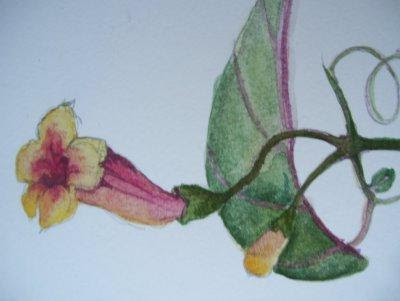
Several fine sketches (along with many photographs, as well) emerged from our time atop Panola Mountain. Below are a few of them: a pine branch in pencil by one of the participants, and a flowering crossvine, atamasco lily, and diamorpha by Valerie Hayes.


Below are a several of the plants I saw blooming during our visit, as captured by a basic point and shoot Kodak EasyShare digital camera. The first two are crossvine (Bignonia capreolata); the next two are atamasco lily (Zephyranthes atamasco); the deep yellow flower is yellow jessamine (Gelsemium sempervirens); below that is the Ohio spiderwort ("officially" known in the vernacular as bluejacket, or more officially as Tradescantia ohiensis); and the bottom photograph shows the fringe tree in flower (Chionanthus virginicus).


Art in the Hill Country, Part Two: Sketching at Panola Mountain

Our Saturday outing in April was a trip to Panola Mountain State Park, and a rare opportunity to engage in field sketching and photography atop the monolith. The granite hill is off limits to visitors, except when accompanied by a park guide on the once-monthly hike or by special arrangement. I was thrilled to be there at this time in the spring, when so many flowers -- including the diamorpha, endemic to such outcrop environments -- were in bloom. I was also grateful to have my wife, Valerie Hayes, along as field sketching instructor.

After we parked the cars along rarely-used dirt access road (beside a lovely stone-edged lake), Valerie shared with the group a number of helpful books on keeping a field journal and doing natural history illustration. Then Brian, a naturalist who has worked at the park for a couple of years, led the six of us along a half-mile trail from an access road uphill to the "peak" (perhaps 200 feet of vertical ascent?). The morning rain had vanished as predicted, and it was a pleasant, mostly sunny day. We established two "base camps" for artwork. We spent perhaps an hour and a half at the first, and about forty-five minutes at the second. Below are photographs from the two locations:
At the first site, I completed a sketch of a cross-vine in flower, then wandered off, drawn by the rich textures and patterns of the landscape and all the flowers in bloom. I took a number of fairly conventional photographs, then Brian remarked to me that I might consider trying to take photographs through a hand lens. He commented that the idea had come to him just then as he saw me using the lens, and simultaneously recalled a photo he had taken through binoculars. The results turned out to be amazing for such a low-tech, slapdash approach. Soon Brian, too, had borrowed a second hand lens for me, and was photographing flowers and lichens. These photographs merit a separate part in this blog, to be continued.

Meanwhile, here are three photographs from the top of Panola. Everything is entrancing -- the juxtapositioning of colors and forms (there will be a separate blog part just on patterns, too), the Japanese-rock-garden-quality of close-up views, and the more distant prospects, whether of granite and pine, or the distant face of Stone Mountain.

Even as we were packing up to leave, I discovered an enormous bush full of white, feathery blooms, and had to dash off to photograph it. There is so much there to encounter -- it is quite simply one of the most spectacular places I have visited in Georgia. At last, though, we all reluctantly gathered our gear, and strode off down the mountain for home.